Mahākāla Explained: The Great Black Protector
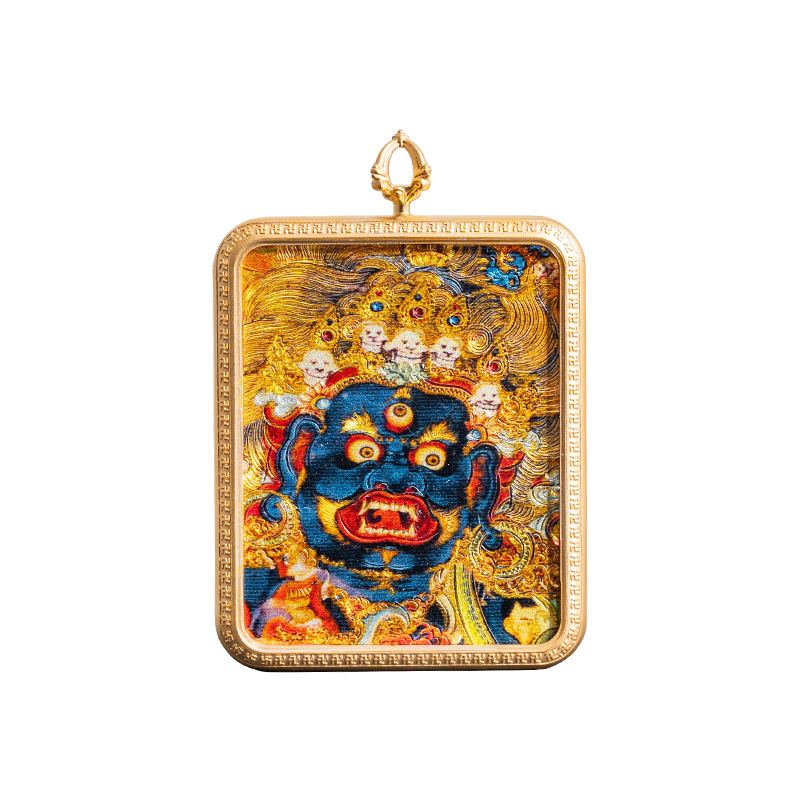
If Green Tārā represents compassion moving swiftly to help, Mahākāla represents something adjacent but different: compassion that has taken on the job of standing guard, so that help has a safe space to happen in the first place.
Who is Mahākāla?
Mahākāla's name combines mahā ("great") and kāla ("time" or "black/dark"), commonly rendered as "the Great Black One." He is one of the most important protector deities (dharmapalas, "protectors of the teaching") across Tibetan Buddhism, with multiple forms and lineage-specific variations, but a consistent core identity as a powerful guardian tasked with removing serious obstacles — both external threats and the deeper internal ones, like habitual harmful patterns, that block genuine progress.
Unlike the eight zodiac guardians covered in our birth-year guide, Mahākāla sits outside that twelve-year system entirely. He is chosen by intention and need rather than birth year, alongside other protector figures like Yellow Jambhala and Green Tārā.
His name and general form trace back to an earlier connection with the Hindu deity Shiva in his fierce aspect (also sometimes called Mahākāla in Shaiva tradition), absorbed into Buddhism in a pattern similar to Jambhala's roots in Kubera, covered in our wealth deity guide. As Buddhism reframed the figure, Mahākāla was recast specifically as a protector of the Dharma rather than a cosmic destroyer, taking on the role he holds in Tibetan practice today.
The many forms of Mahākāla
Mahākāla is not a single fixed image but a family of related forms, each tied to a specific lineage and purpose: a two-armed form known as Bernagchen serves as the principal protector of the Karma Kagyu lineage and its head, the Karmapa; four-armed and six-armed forms are emphasised in other lineages, each with distinct attributes and a slightly different emphasis in what obstacles they are specifically invoked to clear. This variation is normal rather than a sign of inconsistency — dharmapalas across Tibetan Buddhism are frequently tied to particular monasteries, lineages or even specific historical teachers who established their practice, and Mahākāla's many forms reflect centuries of that lineage-specific development.
A state protector, historically
Mahākāla's role has, at points in history, extended well beyond individual practice into political and military life. Most notably, the Sakya teacher Chögyal Phagpa is traditionally credited with introducing a form of Mahākāla practice to Kublai Khan in the thirteenth century, after which Mahākāla was adopted as a protector deity of the Mongol state itself. This history is part of why Mahākāla's worship spread so widely across Mongolia and Mongol-influenced regions of Central Asia, well beyond his role in Tibetan monastic practice alone — a genuinely rare example of a Buddhist protector figure taking on formal state significance.
Why black, why fierce
Black in this context does not carry the negative connotation it often does in other visual traditions. Within Tibetan Buddhist symbolism, black represents the absorption of all colours, a kind of totality — Mahākāla's blackness suggests a protection so complete it does not need to be one particular colour or form; it is simply whatever is needed to hold the line. His fierce expression, flame-wreathed halo and weapons follow the same wrathful-deity logic explained in our Vajrapāṇi guide: intensity in service of protection, not aggression for its own sake.
Fierce protection rooted in compassion
In several lineages, Mahākāla is described as an emanation or protective aspect connected to Avalokiteśvara — the same bodhisattva of compassion covered in our Guanyin guide. The logic mirrors Tārā's own origin story: compassion, faced with obstacles gentleness alone cannot move, takes on a second, fiercer form suited to the job of active protection. Understood this way, Mahākāla is not a separate, harsher force opposed to compassion — he is compassion's protective edge.
Who tends to wear him
Mahākāla is commonly chosen by those facing a genuinely difficult period — a hostile work environment, a health challenge, a household going through instability — where the wish is less for gentle comfort and more for a strong line held around what matters. He is also chosen simply as an everyday protective piece by those drawn to his particular strength of presence.
Common questions
Is Mahākāla considered a "dark" or negative deity?
No — despite the fierce imagery, he is squarely a protector within the tradition, not an adversarial or malevolent figure. The wrathful appearance is a protective posture, not a moral alignment with harm.
Is Mahākāla related to the Hindu god Shiva?
There is a historical connection — the name and fierce form draw on an earlier Shaiva figure also known as Mahākāla — but within Buddhism he was reframed specifically as a Dharma protector, distinct in role and function from his Hindu counterpart.
Why are there so many different forms of Mahākāla?
Different Tibetan Buddhist lineages developed their own specific Mahākāla practices over centuries, each tied to a particular monastery, teacher or protective need, resulting in a genuine family of related forms rather than one single fixed image.
Was Mahākāla really adopted by the Mongol Empire?
Yes — historical accounts credit the Sakya teacher Chögyal Phagpa with introducing Mahākāla practice to Kublai Khan, after which the deity took on a formal protective role tied to the Mongol state, contributing to his wide spread across Mongolia.
How is Mahākāla different from Vajrapāṇi?
Both are wrathful protector figures, but Vajrapāṇi is specifically tied to the vajra and protection of the Buddhist teachings themselves, while Mahākāla is a broader protector figure invoked for removing obstacles in daily life and practice more generally.
Is there more than one form of Mahākāla?
Yes — different lineages within Tibetan Buddhism maintain their own specific forms of Mahākāla (two-armed, four-armed, six-armed and beyond), each with particular iconographic details. Our pendant depicts one of the most widely recognised forms.