Mahāsthāmaprāpta Explained: The Bodhisattva of Great Spiritual Power
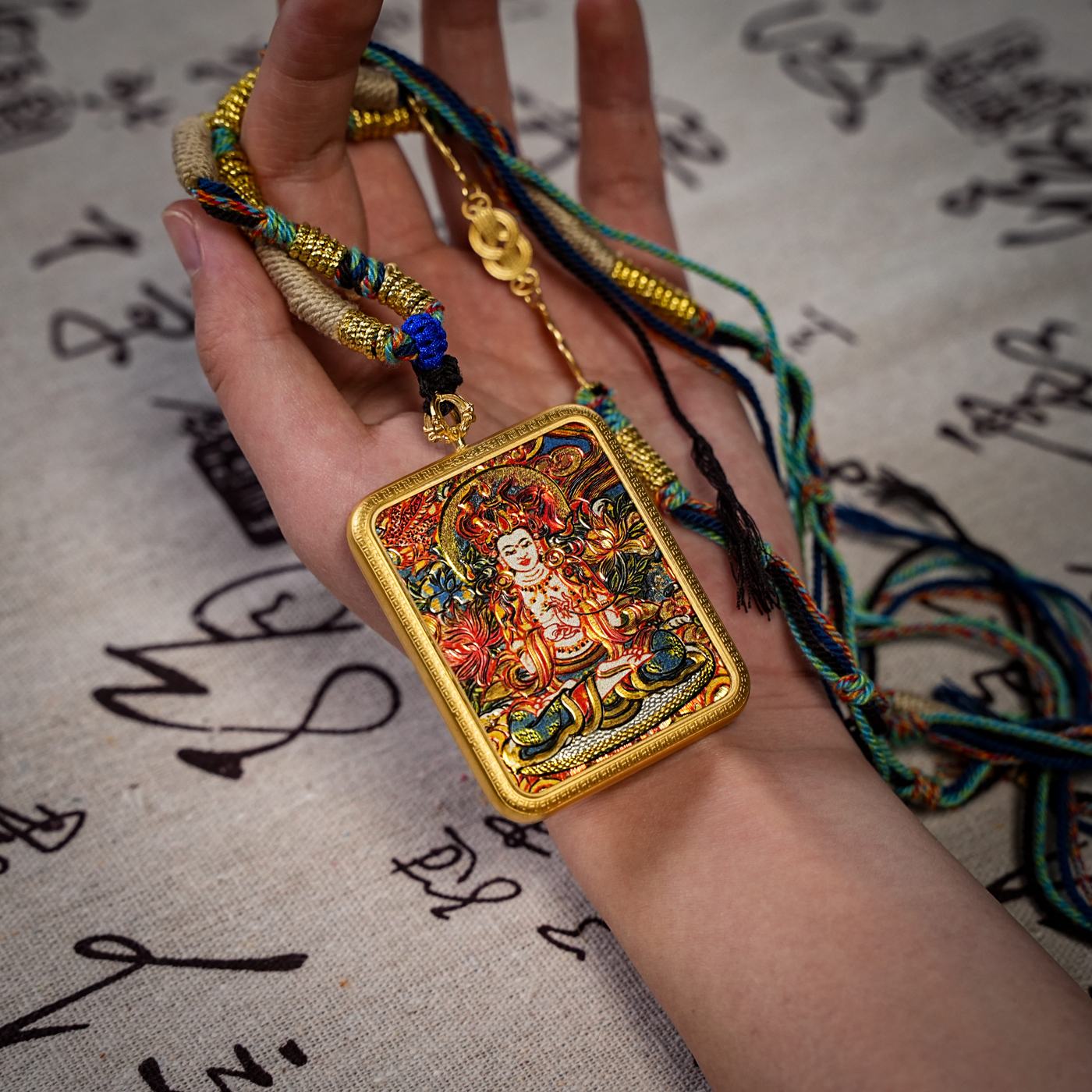
Stand in front of most Amitābha triads and people can usually name two of the three figures. Amitābha Buddha in the centre is unmistakable, and Avalokiteśvara (covered in our Guanyin guide) to one side is instantly recognisable. The third figure, standing at Amitābha's other shoulder, is asked about far less often — which is a shame, because Mahāsthāmaprāpta represents something the other two don't: sheer, tireless spiritual strength, applied quietly rather than announced.
Who is Mahāsthāmaprāpta?
Mahāsthāmaprāpta (大势至菩萨, often shortened in Chinese devotional practice to Dashizhi) is a principal bodhisattva of Mahayana Buddhism and, together with Avalokiteśvara, one of the two chief attendants of Amitābha Buddha in the Pure Land tradition. The three together form what is commonly called the Amitābha Triad or the "Three Sages of the West" (西方三圣) — a grouping found across Chinese, Japanese and Himalayan Buddhist art from cave temples to household shrines. Where Avalokiteśvara embodies compassion, Mahāsthāmaprāpta embodies power and diligence: the capacity to keep going, without wavering, until liberation is reached for oneself and for others.
“The one who has attained great power”
The Sanskrit name Mahāsthāmaprāpta breaks down plainly enough — mahā ("great") and sthāma-prāpta ("one who has attained power" or "one who has arrived at strength"). Classical commentaries are careful to specify what kind of power this is: not physical force or worldly authority, but an unshakeable spiritual resolve — the strength to sustain practice through discouragement, distraction and doubt without ever giving up. In some sutra passages his very presence is described as causing the ground to tremble and the Buddha-realms to shine, a way of signalling that this power is felt rather than merely claimed.
In devotional art he is typically shown standing, calm and upright, sometimes holding a lotus or with hands folded — deliberately undramatic for a figure whose defining trait is inner power rather than outward display. The restraint in his depiction is, in a sense, the whole teaching: real strength doesn't need to perform itself.
The Amitābha Triad: the third figure most people forget
In the Contemplation Sutra (Guan Wuliangshou Jing), one of the three core texts of Pure Land Buddhism, Amitābha, Avalokiteśvara and Mahāsthāmaprāpta are described together as the beings who come to escort a dying practitioner to the Pure Land at the moment of death, provided the conditions of sincere practice have been met. This is why the triad appears so often together — in temple murals, in household altar sets and, in this collection, as a natural pair to wear or gift alongside the Guanyin pendant. Where Avalokiteśvara answers cries of suffering with compassion, Mahāsthāmaprāpta answers with the strength to persevere through it — two responses to the same difficulty, working together rather than separately.
Wisdom-light that reaches everywhere
A recurring detail in the sutras describing Mahāsthāmaprāpta is his "light of wisdom," said to illuminate all realms and free beings from the three lower paths of suffering, allowing them to attain the "unsurpassed power" the bodhisattva himself embodies. Unlike imagery of light as a sudden dramatic event, this light is described as constant and pervasive — always present, always available, whether or not a person happens to notice it in a given moment. It's a fitting metaphor for the quality he represents: strength that doesn't arrive only in a crisis, but that is quietly available at all times to whoever turns toward it.
His role in Pure Land practice
Within Pure Land Buddhism specifically, Mahāsthāmaprāpta is closely associated with the practice of continuous mindful recitation — the idea that sustained, unbroken effort, repeated without interruption, is itself a form of spiritual power. This is sometimes summarised by practitioners as "one thought after another, without a gap" — a description that applies as easily to any long, demanding undertaking as it does to formal religious practice. For this reason he has traditionally been regarded as a guardian well suited to long projects, difficult recoveries, and any situation that calls less for a single burst of effort and more for showing up, steadily, day after day.
Guardian of the Horse year
Within the zodiac guardian system, Mahāsthāmaprāpta is the traditional protector of those born in the Horse year — a pairing that tracks naturally with the Horse's own associations of stamina, drive and forward motion. As with the other seven guardians mapped in our complete zodiac guide, the birth-year pairing is the traditional starting point, though many wearers choose a guardian for the quality it represents rather than strictly by birth year — in this case, endurance and quiet, sustained resolve.
Common questions
Is Mahāsthāmaprāpta the same figure as Dashizhi Bodhisattva?
Yes — Dashizhi (大势至) is the standard Chinese name for Mahāsthāmaprāpta, used interchangeably with the Sanskrit in most Chinese-language Buddhist contexts.
Why is he shown less often than Avalokiteśvara or Amitābha?
Largely because his symbolism is quieter and less visually dramatic — inner strength doesn't lend itself to the same instantly readable imagery as compassion or a Buddha's serene countenance, so his iconography has historically received less independent attention outside the full triad.
Is this guardian suitable as a gift for someone going through a hard, prolonged period?
Very much so — his symbolism of sustained strength through difficulty, rather than a single dramatic rescue, makes him a considered choice for someone facing a long recovery, a demanding project or an extended period of hardship. Our gifting guide covers this kind of situation-based selection in more depth.
Should Mahāsthāmaprāpta and Avalokiteśvara be worn or gifted together?
There's no requirement to, but the pairing has genuine traditional grounding, since the two are described together throughout Pure Land scripture as companion figures beside Amitābha.
What if I wasn't born in a Horse year but feel drawn to this guardian?
That's a common and accepted approach — as our guide to choosing a guardian explains, selecting by the quality you want to cultivate, here sustained strength and perseverance, sits comfortably alongside the traditional birth-year system.