Maitreya Explained: The Future Buddha of Loving-Kindness
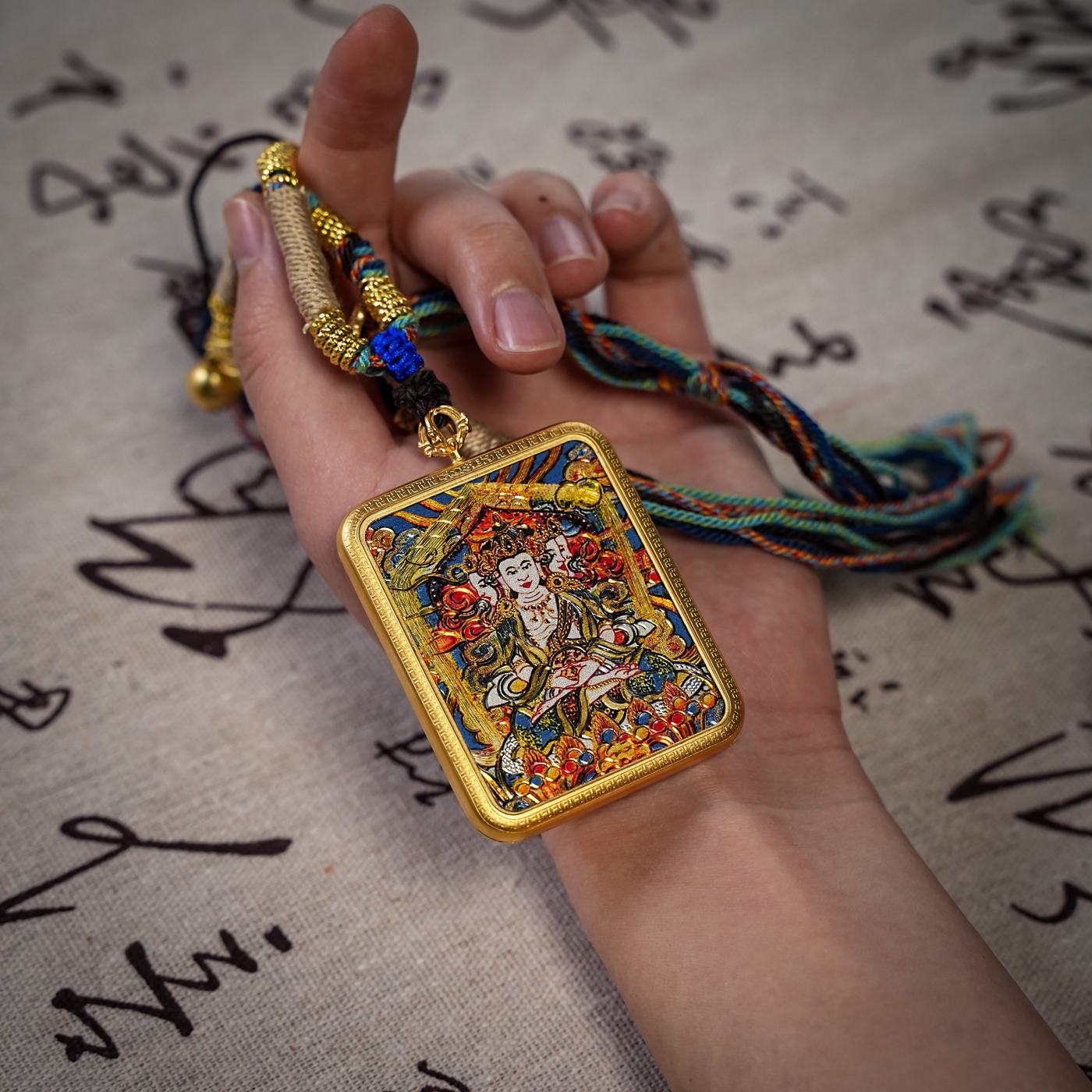
Of all eight zodiac guardians in this collection, Maitreya is arguably the most widely recognised worldwide — and also the most commonly misunderstood, since two very different images circulate under the same name. Understanding the difference is worth a few minutes, because it changes what the pendant actually represents.
Who is Maitreya?
Maitreya (弥勒菩萨, Maitreya Bodhisattva, or 弥勒佛, Maitreya Buddha, depending on the context) holds a unique position in Buddhist cosmology: he is the Buddha of the future. According to Mahayana and Theravada tradition alike, Maitreya currently resides as a bodhisattva and will, at some point in the far future, descend to this world, attain enlightenment, and teach the dharma anew for an age that will have forgotten it. He is one of the very few figures recognised across nearly every Buddhist school and region — Theravada, Mahayana and Vajrayana traditions all include him, which is unusual, since the three traditions otherwise diverge considerably on which bodhisattvas hold central importance.
The meaning of “Maitreya”: loving-kindness
The name Maitreya derives from the Sanskrit maitrī, meaning loving-kindness or benevolence — the same root that gives metta in Pali, one of the four foundational qualities (brahmavihāras) cultivated in Buddhist practice. This is not incidental naming. Maitreya's entire role in Buddhist eschatology is built around loving-kindness as the defining quality of the age he will usher in: a future era of compassion, ease and dharma restored, arriving specifically through a being whose name means kindness itself.
Waiting in Tushita Heaven
Tradition holds that Maitreya currently resides in Tushita Heaven, a celestial realm where bodhisattvas destined for eventual Buddhahood are said to dwell before their final birth on earth — the same realm the historical Buddha Śākyamuni is said to have inhabited before his own birth. Maitreya is described there as continuously teaching the dharma to the beings around him, in preparation for the era, said to be many thousands of years from now, when he will finally descend. This long horizon is itself part of the symbolism: Maitreya represents patience on a cosmic scale, and hope that isn't contingent on anything arriving quickly.
Maitreya and the “Laughing Buddha”: one figure, two images
Here is where most confusion comes in. The round, jovial, big-bellied figure widely known in the West as the "Laughing Buddha" or "Fat Buddha" — often seen in East Asian restaurants and gift shops — is a specifically Chinese folk depiction, traditionally identified with a historical Chinese Chan monk named Budai (布袋, "Cloth Sack"), who lived roughly in the 10th century and was later folk-identified as an incarnation of Maitreya. This cheerful, informal image is a distinctly East Asian popular-culture development, separate from — though now closely associated with — the more formal iconography of Maitreya found in Indian, Tibetan and classical Chinese Buddhist art, where he is typically shown seated in a Western-style pose (feet resting on the ground rather than in full lotus), often holding a stupa, and wearing the crown and ornaments of a bodhisattva rather than the loose, informal robes of Budai. Pendants and thangka in the classical guardian tradition, including the one in this collection, follow the formal bodhisattva depiction rather than the folk Budai image.
A guardian associated with hope and renewal
Because his entire role is future-oriented, Maitreya has long been associated with hope, renewal and the promise that difficult periods eventually give way to better ones. Historically, periods of social or political upheaval in China and Central Asia saw renewed popular devotion to Maitreya specifically, as communities looked toward the promise of his future arrival during hard times. That same association carries into more personal contexts today — a new chapter, a fresh start, a long-awaited change — situations where the wish being expressed is less about immediate rescue and more about trusting that good things are still ahead.
Guardian of the Goat and Monkey years
Within the zodiac guardian system, Maitreya is unusual in protecting two birth years rather than one: both the Goat and the Monkey. As covered in our complete zodiac guide, this dual pairing is part of the traditional eight-guardian framework, where two of the twelve zodiac animals share a single guardian. Outside the birth-year system, Maitreya remains one of the most commonly chosen guardians for anyone marking a transition — a graduation, a move, a new job, a recovery — precisely because of what he represents.
Common questions
Is the pendant in this collection the round “laughing” figure or the seated bodhisattva?
The formal seated bodhisattva depiction, consistent with the classical thangka tradition this collection follows — not the folk Budai (“Laughing Buddha”) image.
Is Maitreya already a Buddha, or still a bodhisattva?
Currently a bodhisattva, by tradition residing in Tushita Heaven; he is understood to become a Buddha only at his future descent to teach the dharma anew.
Why does he protect two zodiac years instead of one?
The eight-guardian, twelve-animal system pairs two of the zodiac years to two of the guardians rather than assigning exactly one guardian per animal; Maitreya covers both Goat and Monkey. The full mapping is in our zodiac guardian guide.
Is Maitreya recognised across all Buddhist traditions, or only some?
Across nearly all of them — Theravada, Mahayana and Vajrayana traditions each include Maitreya, which is notably broader agreement than most other bodhisattvas receive.
Is this a good guardian to gift someone starting something new?
Yes — his association with hope, renewal and a better future ahead makes him a natural choice for a graduation, a new job, a move or any fresh start, regardless of the recipient's birth year. See our gifting guide for more occasion-based suggestions.