Mañjuśrī and the Flaming Sword: A Guardian for Focus and Study
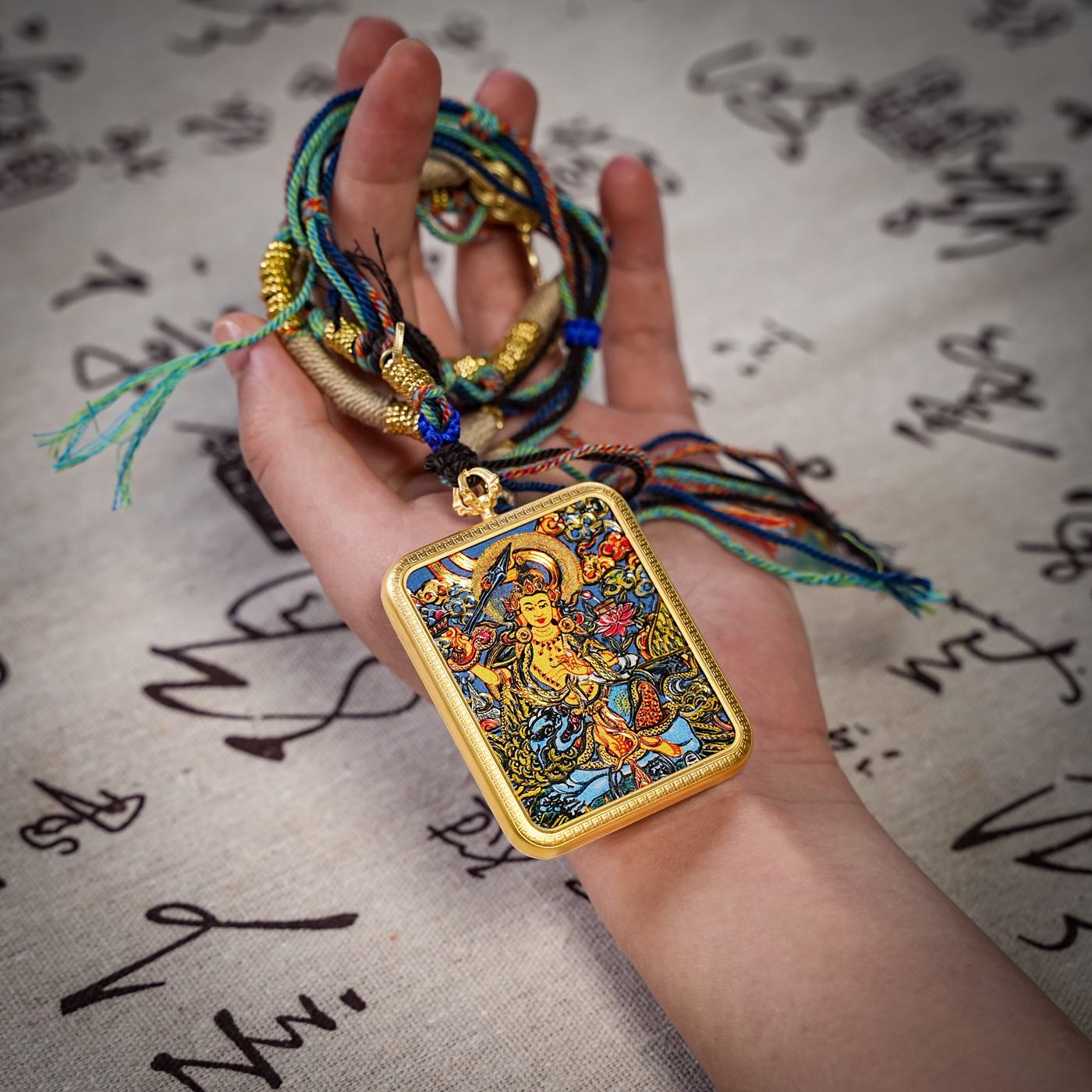
If one guardian in this tradition is most associated with the mind rather than the body, it is Mañjuśrī — a figure worth knowing properly, since his imagery is often recognised without being understood.
Who is Mañjuśrī?
Mañjuśrī (文殊菩萨) is one of the oldest and most widely venerated bodhisattvas in Mahayana Buddhism, traditionally regarded as the embodiment of wisdom itself rather than a teacher of it from the outside. He appears across Chinese, Tibetan, Japanese and Nepalese Buddhist art, frequently paired with Samantabhadra (representing wisdom put into action, covered in our dedicated guide) as two complementary aspects of a fully developed practice. He also plays a prominent role in the Prajñāpāramitā (Perfection of Wisdom) literature and appears as a key dialogue partner in the Vimalakirti Sutra, where his exchange with the layman Vimalakirti on the nature of non-duality is considered one of the most celebrated philosophical passages in the entire Mahayana canon.
The sword and the scripture
Mañjuśrī's two defining attributes are a flaming sword held in his right hand and, resting on a lotus by his shoulder, a copy of the Prajñāpāramitā (Perfection of Wisdom) sutra. Neither is meant literally as a weapon or a textbook. The sword cuts through ignorance and confusion rather than an opponent — a distinction worth sitting with, since it reframes wisdom as something that removes obstruction rather than something that defeats a rival. The scripture represents the wisdom teachings themselves, carried effortlessly rather than studied with visible strain, as though true understanding, once reached, is held lightly.
He is often shown seated on a lion, another detail sometimes read superficially as decoration — traditionally, the lion represents wisdom's fearlessness, roaring without hesitation, once ignorance has genuinely been cut through.
Mount Wutai: his legendary dwelling place
Just as Avalokiteśvara is traditionally associated with the mountain Potalaka (covered in our Guanyin guide), Mañjuśrī is traditionally said to dwell on Mount Wutai (Wutaishan) in Shanxi, China — one of the four sacred mountains of Chinese Buddhism and, for over a thousand years, a major pilgrimage destination specifically associated with seeking his blessing for wisdom and clarity. The mountain's five flat-topped peaks are themselves sometimes read as echoing the five-pointed arrangement of wisdom qualities in tantric symbolism. Pilgrims historically travelled to Wutaishan specifically ahead of important exams, ordinations or major life decisions, a practice that continues in a more modern form today.
The mantra of sharp wisdom
Mañjuśrī is associated with a short, widely known mantra — Om Ah Ra Pa Tsa Na Dhih — traditionally recited to sharpen memory, eloquence and understanding, particularly before study or an exam. It is one of the most commonly taught mantras to children in Tibetan Buddhist families for exactly this reason, and its brevity (compared to longer ritual texts) is part of why it has remained in everyday practical use across centuries, rather than confined to formal ceremony.
A companion for study and decisions
Because of this symbolism, Mañjuśrī has long been the guardian most closely associated with students, examinations, competitive study and moments that call for mental clarity over brute effort. In parts of East Asia it remains common for students to visit a Mañjuśrī shrine or carry his image ahead of major exams, not as a substitute for preparation but as a focusing ritual alongside it.
The same symbolism extends naturally to adult life: a difficult negotiation, a career decision, a return to study later in life — any situation where the useful quality is a clear head rather than raw willpower.
The Rabbit year, and beyond it
Within the zodiac guardian system, Mañjuśrī is the traditional guardian of the Rabbit year specifically. Outside that pairing, he is one of the most commonly gifted guardians regardless of the recipient's actual birth year, precisely because "wisdom and clear decisions" translates so directly as a wish for almost anyone facing a challenge.
Common questions
Is Mañjuśrī only appropriate for students?
Not at all — while the exam association is the most well-known, the underlying symbolism of clarity and cutting through confusion applies to any decision or period of mental strain, at any age.
Is the sword aggressive or violent symbolism?
No — within the tradition it is explicitly understood as cutting through ignorance and confusion, not as an instrument of harm toward any being. This is one of the more commonly misunderstood details in Buddhist iconography for newcomers.
Is Mount Wutai still an active pilgrimage site?
Yes — Wutaishan remains an active Buddhist pilgrimage destination in China today, with numerous monasteries and temples associated with Mañjuśrī still in regular use.
Do I need to know the mantra to benefit from wearing this pendant?
No — the pendant itself functions as a daily visual reminder of the qualities Mañjuśrī represents; reciting the mantra is an optional practice some wearers choose to add, not a requirement.
What if I'm not born in a Rabbit year but feel drawn to Mañjuśrī?
That's entirely fine — as covered in our guide to choosing a guardian, selecting by the quality you want to cultivate is a widely accepted approach alongside the birth-year pairing.